
How to Measure Training Impact on OKRs in 9 Simple Steps
I get it—figuring out whether your training actually moves the needle can feel like a guessing game. You can see who clicked “enroll,” sure. But does that translate into better performance, faster delivery, happier customers, or hitting your OKRs? In my experience, that’s the part most teams struggle with.
What I like about a good OKR + training measurement approach is that it stops the hand-waving. You’re not just asking, “Did people complete the course?” You’re asking, “Did this training change outcomes we care about?” And once you track the right things, you can adjust the program instead of just hoping for the best.
If you stick with me, I’ll walk you through practical steps to measure training impact on OKRs. We’ll cover everything from mapping learning objectives to outcomes, to choosing metrics, to setting baselines, to calculating ROI (without making it feel like a finance exam). Ready?
Key Takeaways
- Link training objectives to your company’s OKRs by turning “what people should learn” into measurable learning outcomes, then mapping those outcomes to the specific OKR you’re trying to improve. No vague connections.
- Pick metrics that show learning transfer, not just participation. Completion rates are fine as a starting point, but you’ll want retention tests, skill checks, and behavior signals tied to business results.
- Track participation and engagement consistently: enrollments, attendance, quiz attempts, time-on-task, and content completion rates. If engagement dips, it usually shows up before outcomes do.
- Use LMS and survey tools to collect data automatically and keep it organized. Dashboards help you spot which cohort improved—and which one didn’t.
- Calculate ROI using pre/post baselines and training costs. If you want a more complete evaluation, use the Kirkpatrick model to structure reaction, learning, behavior, and results.
- Expect measurement challenges: training rarely happens in a vacuum. Use control groups or comparison cohorts when you can, and be disciplined about what you attribute to training.
- Treat measurement like a loop, not a report. Review results on a schedule (I usually prefer monthly or quarterly), then refine content, delivery, and targeting.

Link Training Objectives to OKRs (so you’re not measuring the wrong thing)
The first step is making sure your training goals actually support your company’s main objectives, or OKRs. If you don’t do this, you end up measuring “training success” instead of business impact. And honestly? That’s how budgets get cut.
Here’s what I do: I start by writing a simple learning objective that’s specific and observable. Not “learn about customer retention.” More like, “Use a retention playbook to identify churn risk and recommend next-best actions during customer check-ins.”
Then I connect that learning objective to the OKR. For example:
- OKR: Improve customer retention from 82% to 86% by Q3.
- Training objective: Equip customer success reps to run churn-risk check-ins using the playbook.
- Expected behavior: Reps create risk notes and recommend next-best actions within 24 hours of a flagged account.
To keep this from getting messy, I use a mapping chart with three columns: Training objective, Relevant OKR, and What will change in the business. You can do this in a spreadsheet in 15 minutes.
Quick self-check: if you read your training plan out loud, could someone in leadership point to the OKR it supports? If not, you’ve got a mismatch.
Identify Key Metrics for Measuring Impact (beyond completion rates)
Next, pick metrics that connect learning to outcomes. This is where most teams fall short. They track completion, maybe quiz scores, and then assume the rest will magically happen.
Instead, choose metrics in three layers:
- Learning metrics: quiz accuracy, scenario performance, knowledge retention test scores.
- Behavior metrics: adoption signals like “how often managers see the new process used,” usage of templates, quality checks, or changes in workflow data.
- Business metrics: the OKR outcome itself (sales, retention, cycle time, defects, etc.).
Concrete examples (use whichever fits your OKR):
- Sales OKR: pipeline conversion rate, win rate, average deal cycle length, quota attainment.
- Onboarding OKR: time-to-productivity (weeks), ramp-up assessment score, first-90-day performance rating.
- Engineering OKR: sprint velocity trend, defect escape rate, lead time, or incident counts.
- Customer success OKR: churn rate, NPS change, ticket resolution time, repeat contact rate.
In my experience, the “best” metrics are the ones you can measure consistently for both participants and a comparison group (even if it’s just another team that isn’t trained yet).
One practical tip: pull engagement metrics from your LMS (enrollments, attendance, time-on-module, quiz attempts) and then link them to outcome metrics from your business systems (CRM, HRIS, Jira, Zendesk, etc.). That linkage is what turns training into evidence.
If you need an easy way to structure learning data, you can compare platforms here: LMS platforms. (I’m not saying the platform “does the strategy”—but it makes the data collection way less painful.)
Track Participation and Engagement Rates (because low attendance kills impact)
Engagement is the fuel that keeps training effective. If people don’t show up—or they skim and move on—you can’t expect behavior change.
Here’s the participation data I track every time:
- Enrollment rate: how many eligible people actually enrolled (not everyone will).
- Attendance rate: for live sessions, how many attended at least 80% of the time.
- Completion rate: course/module completion, but also time-on-task if your LMS supports it.
- Assessment participation: quiz attempts and average score, not just “passed.”
- Content interaction: downloads, resource views, or scenario completion.
What I noticed in one rollout: completion was “fine,” but time-on-task was low for a specific department. When we reviewed the cases they worked on, it turned out they weren’t applying the playbook because the examples didn’t match their customer segment. If we only looked at completion, we would’ve missed the real problem.
To improve participation without getting annoying, I like a simple cadence:
- Reminder 1: 7 days before start date
- Reminder 2: 24 hours before
- Reminder 3: “last chance” email with a clear benefit statement
You can also use LMS analytics to see who’s actually engaging with content: learning platform analytics. And don’t skip quick feedback after sessions—if people are confused, your metrics will look worse later.
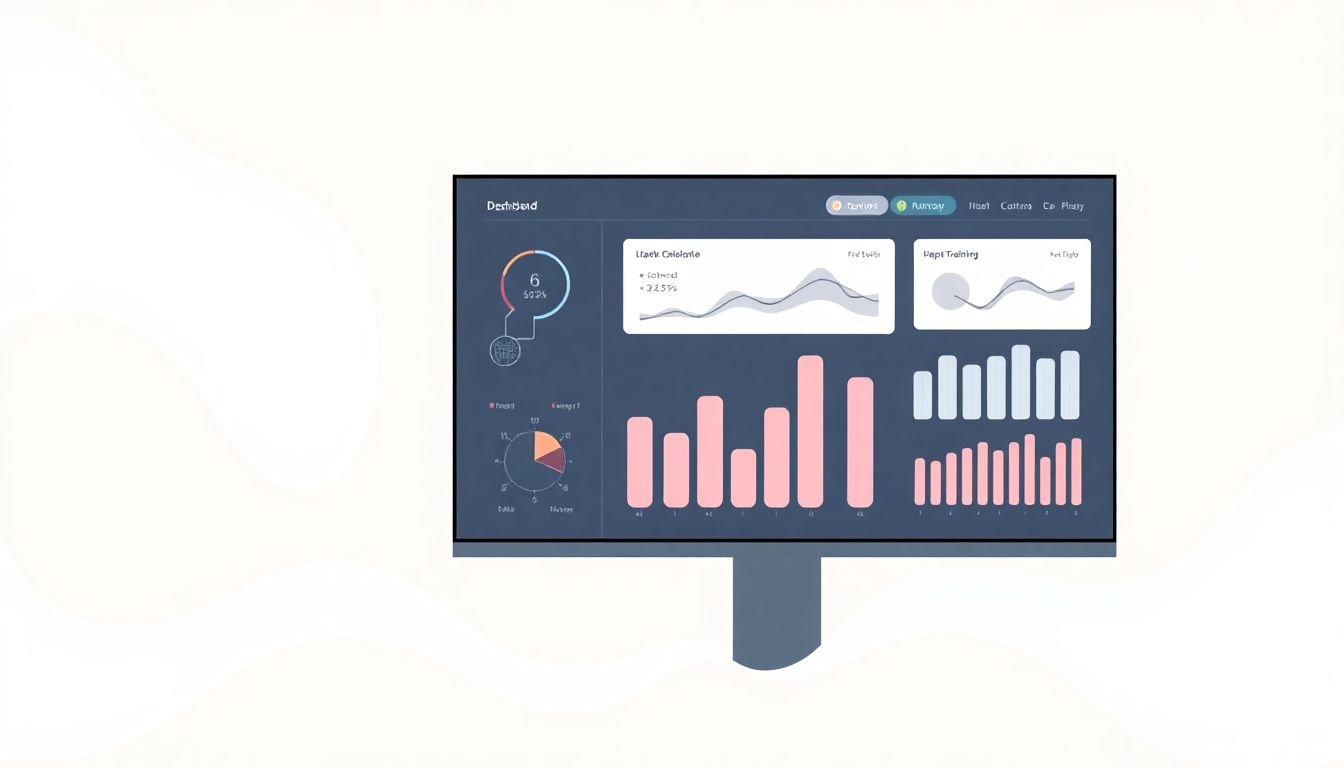
Use Tools for Monitoring Training Impact (dashboards + feedback loops)
Keeping tabs on training impact doesn’t have to be guesswork anymore—technology helps a lot. An LMS can capture the “learning side” (enrollment, completion, quizzes, time-on-module). Then you connect it to business metrics from your CRM, HR systems, support tools, or product analytics.
For example, using an LMS like Thinkific or Teachable (or any similar platform) gives you the raw data you need without manual spreadsheets for every cohort.
Here’s what to include in your monitoring dashboard:
- Cohort view: who was trained (team, location, manager, role)
- Engagement metrics: enrollments, attendance, completion, quiz average
- Adoption metrics: template usage, workflow compliance, observed behaviors
- Outcome metrics: the OKR number, tracked over time
Also, don’t rely only on numbers. Add a short survey right after training and another one 4–6 weeks later. Example questions I’ve used:
- “How confident are you using the new process in your day-to-day work?” (1–5)
- “In the last two weeks, how often have you applied what you learned?” (Never / Once / Weekly / Daily)
- “What’s getting in the way?” (multiple choice + free text)
That second survey is important. Early satisfaction is nice, but it doesn’t prove behavior change.
Calculate ROI of Training Initiatives (with real inputs and a worked example)
Understanding whether training dollars pay off matters even more when budgets tighten. ROI shouldn’t be a mystery—it should be a straightforward calculation based on measurable improvements.
Start with baselines. You need the same metrics before training and after training. The key is picking a window that makes sense for your business cycle.
Here’s a worked example you can copy.
Example: Sales Enablement OKR
OKR: Increase win rate from 22% to 25% in Q2.
Training: 4-week sales negotiation and discovery skills program for Account Executives.
Baseline (4 weeks pre-training):
- Deals closed: 400
- Wins: 88 (22%)
Post-training measurement window (8 weeks):
- Deals closed: 420
- Wins: 121 (28.8%)
Incremental win lift: 28.8% - 22% = 6.8 percentage points.
Incremental wins: 420 * 6.8% = 28.56 ≈ 29 additional wins.
Average revenue per win: $18,000
Estimated incremental revenue: 29 * $18,000 = $522,000
Training costs:
- Facilitators + materials: $35,000
- LMS + admin time: $8,000
- Employee time (opportunity cost estimate): $12,000
Total costs: $55,000
ROI: (Benefits - Costs) / Costs = ($522,000 - $55,000) / $55,000 = 8.49 ≈ 849%
Is this “perfect”? No model ever is. But it’s defensible because it’s tied to a specific OKR metric with clear assumptions.
If you want a structured evaluation framework, the Kirkpatrick Model is a common way to organize training measurement across reaction, learning, behavior, and results.
Also—quick honesty note: I don’t like using random ROI numbers without a source. The “up to 3,900% ROI” type of claim often floats around without a traceable study or real context. If you see a big ROI figure, ask: what company, what timeframe, what costs included, and how did they isolate training impact? If those details aren’t there, treat it as marketing, not evidence.
A better approach is to build your own ROI story based on your OKR metrics and your actual training costs. You’ll get more credibility internally—and you’ll learn what to improve next time.
Address Challenges in Training Measurement (because attribution is hard)
Let’s be real: measuring training impact isn’t always smooth. Two problems show up again and again.
1) Isolating training effects. Training competes with other changes—new tools, process updates, market shifts, hiring waves. If you don’t account for that, you’ll over-credit (or under-credit) training.
What helps:
- Use a comparison group: another team or region that hasn’t been trained yet.
- Stagger the rollout: train Team A first, Team B later. Then compare outcomes in the same time period.
- Track “other changes”: document major initiatives happening during the measurement window so you can explain anomalies.
2) Data overload. Teams collect too many metrics and end up with dashboards nobody trusts. Prioritize the metrics that directly support the OKR and the learning objectives you mapped earlier.
One simple rule: if a metric can’t help answer “Did this training improve the OKR?” then it’s probably a secondary metric.
Leadership buy-in is another practical hurdle. If stakeholders don’t agree on the baseline, window, and success criteria upfront, you’ll fight about results later. Get alignment early, even if it’s a short meeting.
Implement Ongoing Action Steps for Improvement (turn measurement into decisions)
Training measurement shouldn’t be a one-time report. It’s a loop: measure → learn → adjust → re-measure. That’s how you actually improve impact over time.
Here’s a cadence that works for most teams:
- After training (Week 0–2): check engagement + immediate feedback + quiz results.
- Adoption check (Week 4–6): survey managers and participants about behavior change.
- Outcome review (Month 1–3): compare OKR metrics vs baseline and vs a comparison group.
When you find gaps, don’t just tweak the course—tweak the delivery and targeting too. Example: if quiz scores are good but behavior adoption is low, the issue might be practice opportunities, manager reinforcement, or workflow friction.
If quizzes feel stale or people rush through, I’ve had success switching to scenario-based questions or short interactive exercises. It’s not about “gamification for fun.” It’s about making the assessment reflect real work.
And yes—celebrate wins. When a cohort improves the OKR metric, share it. People need to see that training isn’t just content—it’s performance improvement.
FAQs
You connect them by defining learning objectives that lead to measurable behavior changes, then mapping those behaviors to the OKR outcome. When you do it right, training isn’t a “nice to have”—it’s directly tied to strategic priorities.
Use a mix: participation and engagement (enrollment, attendance, completion), learning (quiz scores, retention checks), behavior/adoption (workflow signals, manager observations), and the business outcome tied to the OKR. Completion alone isn’t enough.
Calculate ROI by estimating the monetary value of improvements (like revenue lift, reduced time-to-productivity, fewer defects) and subtracting training costs. Use baselines and a clear measurement window so your assumptions are defensible.
An LMS for engagement and learning data, plus dashboards for connecting those signals to business outcomes. Surveys (immediate and follow-up) and performance systems (CRM/HR/Jira/support) round out the picture.