Sailboat Navigation Theory Online: 9 Easy How-To Steps
If you’ve ever wondered how sailors actually find their way when there’s nothing but water in every direction, you’re not alone. I remember the first time I tried to “wing it” with just a plotter and a vague sense of direction. It was fine… until it wasn’t. The chart details, the bearings, the little visual clues—those are what turn “I think we’re going the right way” into “we’re really on track.”
So here’s the deal: sailboat navigation isn’t mystical. It’s a set of repeatable steps you can learn, practice, and get confident with. Below are 9 easy how-to steps I use as a mental checklist every time I set up a route—whether I’m cruising near shore or working a trickier passage.
Quick note on tools: electronics are great, but they’re not the plan. I treat GPS/chartplotters and radar as “verification,” not the whole navigation system.
9 Easy How-To Steps: Sailboat Navigation Theory (Start Here)
- Step 1: Understand the navigation basics (true vs. magnetic, speed/heading, what charts are really telling you).
- Step 2: Know your position using latitude/longitude and a repeatable plotting routine.
- Step 3: Master core navigation techniques (dead reckoning, bearings, and cross-bearing).
- Step 4: Learn navigational aids and recognize common markers (IALA-style logic).
- Step 5: Navigate with awareness of currents and winds (set/drift corrections).
- Step 6: Use electronic and radar navigation tools (and know their failure modes).
- Step 7: Follow practical tips for safe navigation (route plan + lookout + comms).
- Step 8: Keep improving your navigation skills (practice drills that actually build competence).
- Step 9: Use a final 9-step checklist before and during your trip.
Step 1: Understand Navigation Basics for Sailboats
Navigation isn’t just “point the bow north.” It’s a bunch of small decisions that add up: where you are, where you’re going, and what’s pushing you off course.
In my experience, the fundamentals that matter most are:
- Speed and heading: speed tells you how fast you cover distance, heading tells you the direction you intend to travel.
- True vs. magnetic: your compass reads magnetic direction, while charts (and many bearings) are based on true bearings. You’ll need your local variation and your compass deviation (more on that later).
- Charts are not decoration: they show depth contours, shoals, rocks, channel limits, and the exact placement of aids to navigation.
- Lookouts are part of navigation: if you only trust instruments, you’ll miss what’s right in front of you—especially in glare, rain, or at night.
I once misread a situation where the “obvious” landmark line looked right, but the charted depth and the channel geometry told a different story. The lesson stuck: charts don’t care what seems intuitive.
Step 2: Know Your Position (Latitude and Longitude Usage)
Latitude and longitude are basically the map coordinates for the ocean. Even if you’re using a GPS/chartplotter, you still need to understand how to verify and plot positions—because electronics can drift, lock onto the wrong datum, or simply be wrong due to setup.
Here’s the practical way I approach it:
- Latitude tells you how far north/south you are.
- Longitude tells you how far east/west you are.
- Plot your position regularly—not “someday.” I do it about every hour (more often in busy water, narrow channels, or near hazards).
Example: If you’re seeing 37°00.0’ N and 122°00.0’ W, you’re in the general San Francisco area. The exact spot depends on minutes/seconds and the precision of your readout.
Action step: On a paper chart, mark your position with a dot, label it with time (like “13:20”), and connect it to your last fix. That one habit makes dead reckoning and cross-bearing way easier later.
Step 3: Master Core Navigation Techniques (Dead Reckoning + Bearings)
This is the heart of navigation theory: you combine intended movement (heading + speed) with observations (bearings, landmarks, radar contacts) to keep your position accurate.
Dead reckoning (worked example)
Dead reckoning is predicting where you’ll be based on what you did. Then you correct it using what you observe.
Worked example:
- Speed through water: 5.0 knots
- Time underway: 2 hours
- Distance traveled (in nautical miles): distance = speed × time = 5.0 × 2 = 10.0 NM
- Intended course (heading): 045° (you’d convert to true/magnetic depending on what your chart uses)
So you’d plot a position about 10 NM along your intended track from your last known fix.
Now apply set and drift (currents don’t “care” that you’re trying to sail a straight line):
- Current set: 180° (toward south)
- Current drift: 1.5 knots
- Time: 2 hours
- Current drift distance: 1.5 × 2 = 3.0 NM
What you do: Instead of landing on your “pure dead reckoning” point, you move your predicted position 3 NM in the direction of the current set (and then you compare with what you actually observe).
I’ve had this save me when GPS said “you’re fine” but the water told a different story—especially after tacking in a tidal area.
Taking bearings (and avoiding the most common mistake)
Bearings are how you “measure” your position. The most common mistake I see (and made myself early on) is mixing up what you’re actually measuring.
- Make sure your bearing is referenced correctly: true or
- Use the right compass mode: if your compass is on “magnetic,” don’t treat it like true without applying variation/deviation.
- Write down the time and the object you’re bearing (landmark, buoy, masthead light, etc.).
Action step: Take a bearing, plot the line on the chart, then take a second bearing to a different object. Your position is at the intersection (or best-fit area if the lines don’t perfectly cross due to errors).
Cross-bearing with a simple numeric example
Cross-bearing is when you line up two fixed points and use the fact that your position must lie somewhere along each bearing line.
Example (numbers, not theory):
- You take a bearing on Landmark A: 100°T
- You take a bearing on Landmark B: 030°T
On the chart, you draw a line from Landmark A at 100°T (direction from A toward you). Then you draw a line from Landmark B at 030°T. Where those two lines intersect is your position fix (again, adjusted for plotting accuracy).
If the lines don’t intersect cleanly, don’t panic—just know that compass error, object movement (if the “landmark” is actually a moving vessel), and chart scale can all create a “best estimate” area.
Step 4: Learn Navigational Aids and Recognize Common Markers
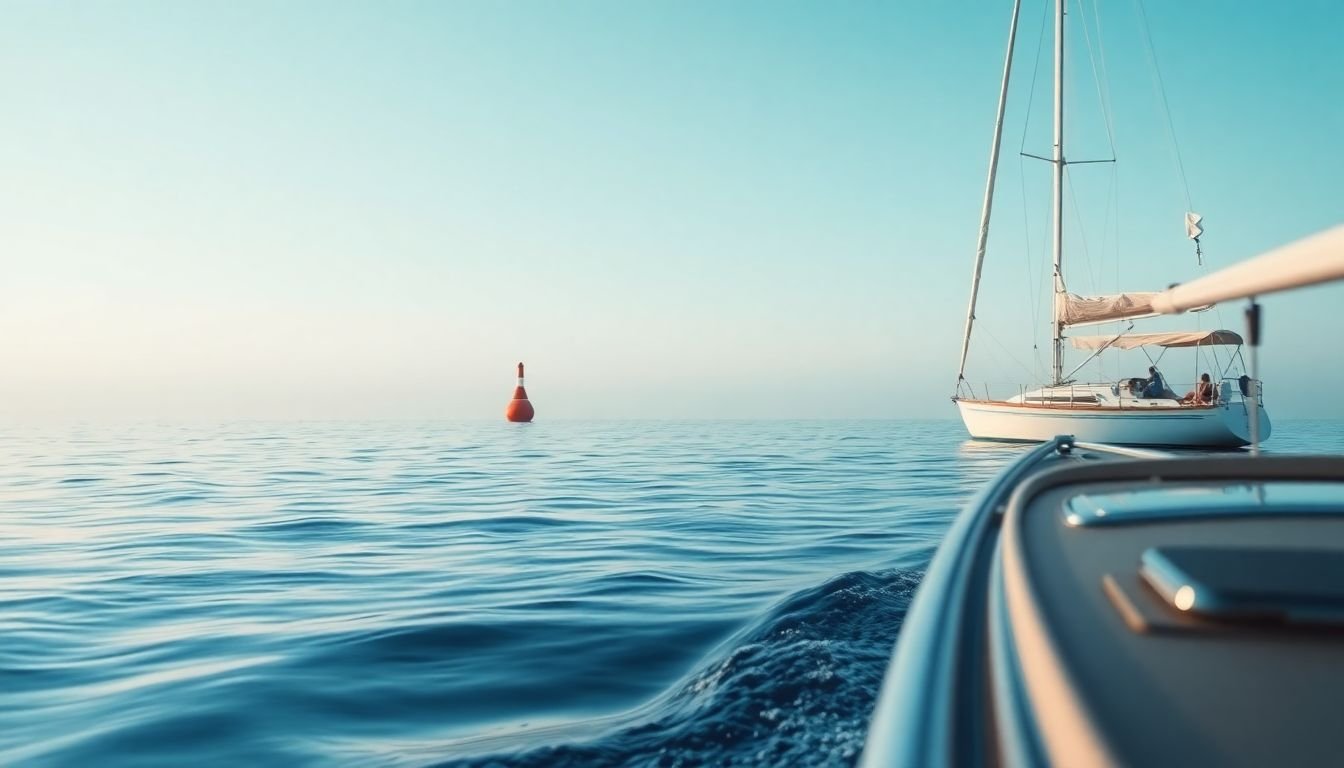
Buoys and beacons aren’t random. They’re a language. Once you learn the “grammar,” navigation gets a lot less stressful.
Here’s what to focus on:
- Lateral marks (the classic red/green logic depending on region): they indicate the sides of channels.
- Cardinal marks: they tell you where the safe water is relative to North/East/South/West.
- Isolated danger marks: they mark hazards that don’t have a channel running past them.
Practical tip: Before you leave the dock, open your chart and locate the exact aids you’ll pass. That way, when you see them at night or in rough visibility, you’re not trying to “figure it out” on the fly.
A quick IALA-style memory aid (and a real-world check)
In many places, red and green indicate port and starboard sides of the channel—but the direction can depend on whether you’re entering from seaward or heading out. So instead of relying only on color, use the chart legend and the “from seaward” note.
I also recommend using this simple check: if the buoy you think you’re passing doesn’t match the channel shape on the chart, slow down and verify. That moment of caution can prevent a “too close for comfort” situation.
Step 5: Navigate with Awareness of Currents and Winds
Currents and wind are the reason dead reckoning works… until it doesn’t. They change your track, your speed over ground, and sometimes your ability to safely make a passage.
Here’s what I do before I commit to a course:
- Check tide/current predictions for your area (and the time window you’ll be there).
- Plan around slack water when possible—especially in narrow channels or near tidal hazards.
- Watch wind direction and gust patterns, not just average speed.
Example: If current data suggests a drift of 2 knots southward during your passage, you’ll likely need to steer a heading that offsets that drift. In practice, that means your “made good” track will differ from your intended course, and you’ll correct after each fix.
For wind, I keep it simple: if the wind shifts, your sail plan changes and your effective track changes too. Don’t just plot the course—plot the likely sail behavior.
Step 6: Use Electronic and Radar Navigation Tools (Without Getting Fooled)
Electronics are fantastic. I just don’t let them make me lazy.
Use a verification workflow:
- Chartplotter/GPS: confirm your position, then cross-check against charted features (shoreline shape, channel markers, depth changes if you have depth sounder data).
- Waypoints: set them, but don’t “autopilot the idea.” Keep an eye on whether the boat is actually tracking the planned path.
- Compass: know what your compass is telling you and whether it’s corrected for deviation.
- Radar: use it to detect contacts and confirm ranges/relative motion, especially in low visibility.
Radar setup checklist (what I actually adjust)
- Range scale: pick a scale that gives you enough detail without clutter (start broader, then tighten).
- Gain: increase until you see consistent returns, but avoid painting everything with noise.
- Clutter controls: reduce sea clutter and rain clutter so targets don’t disappear.
- EBL/VRM (if your unit has it): use it to estimate bearing and range to a target and compare it with what you expect from the chart/position.
Important: radar can show false echoes, and AIS can show stale or incorrect information. When radar/AIS disagree with your visual contact, I trust the physics first: your eyes, your bearings, and your chart geometry.
Step 7: Follow Practical Tips for Safe Navigation
Navigation and safety are linked. A “perfect course” means nothing if you can’t avoid hazards or react in time.
- Route plan before departure: include distance, estimated time, tide/current window, and escape options.
- Lookout discipline: don’t stare at one spot. Scan broadly—think “around the horizon,” not just straight ahead.
- Keep comms ready: carry a working VHF radio, know your channels, and practice basic calling procedures.
- Update your chart approach: check for chart updates/notices if you’re heading into an area with frequent changes.
- Stay inside the safe limits: use charted channel boundaries and don’t assume “it looks wide enough.” Depth and currents can surprise you.
- Emergency plan: man overboard procedure, towing/engine issues, and what you’ll do if you lose electronics.
One thing I’m picky about: if I’m relying on a chartplotter, I still want a backup mental picture of where the hazards are. Electronics can fail at the worst time.
Step 8: Keep Improving Your Navigation Skills
Navigation improves with drills, not just reading. If you want to get better fast, practice the exact tasks you’ll do under pressure.
Here are drills that actually help:
- Plot-and-compare: plot your position on paper every hour, then compare it to your GPS fix. Learn where your system is biased.
- Practice bearings: pick two shore landmarks and practice taking bearings and plotting them without rushing.
- Simulate “electronics down”: intentionally turn off one data source (like the moving map) during a calm day and navigate using bearings + chart.
- Radar practice: in safe conditions, practice identifying targets and using EBL/VRM to estimate range.
I’ve also found that joining a local sailing club or doing a formal navigation session is worth it—because someone can correct your habits before they become expensive mistakes.
Step 9: 9-Step Checklist + FAQs
Final 9-step checklist (use this before you cast off)
- 1. Confirm your compass setup: know variation/deviation and which heading format you’re using.
- 2. Identify your departure point and your first intended fix.
- 3. Plot the route on a chart (paper or digital) and mark key waypoints/hazards.
- 4. Practice dead reckoning for the first leg (distance = speed × time) and plan where you’ll verify.
- 5. Plan for set/drift: estimate current effects and where you expect to be.
- 6. Identify navigational aids you’ll pass and review their meanings on the chart.
- 7. Set up electronics: chartplotter waypoints, radar basics, and confirm your position accuracy.
- 8. Make a safety plan: lookout roles, VHF channels, and an emergency response mindset.
- 9. During the trip: take fixes, take bearings, and correct early—don’t wait until you’re close to the hazard.
Start with the basics: reading nautical charts, understanding compass direction (true vs. magnetic), taking bearings, and plotting fixes. Then add core techniques like dead reckoning and cross-bearing so you can verify your position even if electronics act up.
Use GPS/chartplotter coordinates to get a starting point, then confirm by plotting on your chart (or by matching visible landmarks/aids). If your chartplotter gives you coordinates, your job is to translate that into a plotted fix and check it against the surrounding chart features.
Most boats use a chartplotter/GPS, a compass, and nautical charts. Many also carry radar for low visibility and VHF for communication. Traditional skills (bearings, recognizing buoys, and using the sun/stars) still matter because they’re your backup when tech fails.
Because they change your track and speed over ground. Currents create set and drift, which means your actual path won’t match your intended course. Wind affects your ability to steer and your speed, so it influences how quickly you reach waypoints and how much you drift toward hazards.
- Common mistakes I’ve seen (and try to avoid):
- Plotting a course but never plotting fixes (so you don’t notice you’re off until it’s too late).
- Assuming compass readings are “true” without applying variation/deviation.
- Trusting one device without cross-checking with chart geometry or bearings.
- Ignoring tidal/current timing and only looking at distance.
If you take nothing else from this, take this: navigation is a loop. You plan, you observe, you correct, and you keep doing it. That’s how sailboats stay confident out there—even when the sea gets moody.