
How to Facilitate Mastermind Pods Within Cohorts in 10 Simple Steps
I get it—getting a group of people to work together effectively can feel tricky. I’ve watched pods fall apart for the same reasons over and over: people didn’t know what “good” looked like, someone dominated the call, and a couple members started holding back because they didn’t trust the room. It’s not that people are bad—it’s that the system wasn’t set up.
When it’s set up right, mastermind pods inside cohorts can be one of the most practical parts of the whole program. Not fluffy motivation. Real accountability, real feedback, and momentum that actually carries between sessions.
In the sections below, I’ll walk you through 10 simple steps you can run with, including sample agendas, a pod charter outline, decision rules, and even the exact questions I use for feedback surveys.
Key Takeaways
Key Takeaways
- Define a purpose you can measure (not just “support each other”)—then translate it into 2–3 outcomes for the cohort.
- Pick committed participants with complementary skills and a track record of showing up and responding to messages.
- Use a repeatable meeting format (time-boxed agenda + action commitments) so momentum doesn’t depend on whoever’s facilitating.
- Split into subgroups based on specific goals (e.g., lead gen, onboarding, retention) to keep feedback relevant and deeper.
- Bring in guest experts or curated resources intentionally—tie each guest to a pod problem members are actively solving.
- Run continuous learning between calls with short challenges (weekly or biweekly) instead of vague “read more” assignments.
- Track both leading and lagging indicators (inputs and outcomes) so you can spot issues before they stall.
- Collect feedback on a schedule (after session 2 and session 6 is a great start) and actually adjust the format.
- Manage dynamics with clear norms: confidentiality, participation expectations, and a plan for handling conflict early.
- Build community beyond the meeting with lightweight spaces (Slack/Discord) plus periodic social prompts that don’t feel forced.

1. Start With a Purpose You Can Actually Measure
Before you assemble your mastermind pod, I recommend you write down what you’re trying to change. Not “support.” Not “network.” Change.
Ask: are you trying to boost sales, improve onboarding, speed up content production, or help members ship projects they keep postponing?
Then translate that into 2–3 concrete outcomes. Here are a few examples you can copy:
- Lead generation pod: “By week 6, each member will have 1 lead magnet live and 20 leads captured (or equivalent pipeline created).”
- Product pod: “By week 8, members will run 2 customer interviews and produce 1 prioritized roadmap draft.”
- Career pod: “By session 5, members will have a revised resume + a targeted outreach plan with 10 messages sent.”
Once you have outcomes, you can build agendas that reinforce them. Without that, meetings drift into stories and advice without action. And honestly? People stop trusting the time.
2. Choose Participants Carefully (It’s Not Just About Skill)
Pick folks who are committed, supportive, and bring something useful. But don’t stop at competence—look at reliability.
What I look for:
- Consistency: Can they make the scheduled time and respond between sessions?
- Contribution style: Are they willing to give feedback (not just receive it)?
- Complementary strengths: Someone who’s great at strategy pairs well with someone who’s great at execution.
- Psychological safety: Do they speak respectfully, especially when disagreeing?
For example, if your cohort is mostly tech founders, I’d still try to include at least one person who’s strong in marketing or customer discovery. That mix changes the quality of feedback fast.
Quick practical filter: ask applicants to answer two questions in writing (even briefly): “What are you working on right now?” and “What’s one piece of feedback you’ve given that you’re proud of?” You’ll learn a lot from how they respond.
3. Put the Structure on Rails: Time-Boxed Agendas + a Repeatable Cadence
Meeting frequency matters, but structure matters more. In my experience, biweekly works well for most cohorts (enough time to do work, not so long that momentum dies). Monthly can work too, but only if you’re strict about between-call tasks.
Here’s a simple 60-minute pod agenda you can reuse every session:
- 0–10 min: Wins + progress check (each person: 2 minutes, one metric or artifact)
- 10–35 min: Deep dive on 1 primary challenge (group asks clarifying questions)
- 35–50 min: Feedback round (each member offers 1–2 suggestions max)
- 50–58 min: Commitments (who will do what by when)
- 58–60 min: Quick close (one “what I’m taking away” + next meeting date)
Now, send reminders with a calendar link and a “pre-work” prompt 24 hours before the call. Pre-work keeps the meeting from becoming a recap.
Pre-work template (send the day before):
- What changed since last time? (1–2 bullets)
- What’s the biggest blocker right now? (one sentence)
- What do you want feedback on during the call? (choose one)
- One commitment you can make before the next session. (date + deliverable)
Tools: Zoom + Google Calendar are fine. The real win is having a single shared doc where you track commitments and follow-ups.
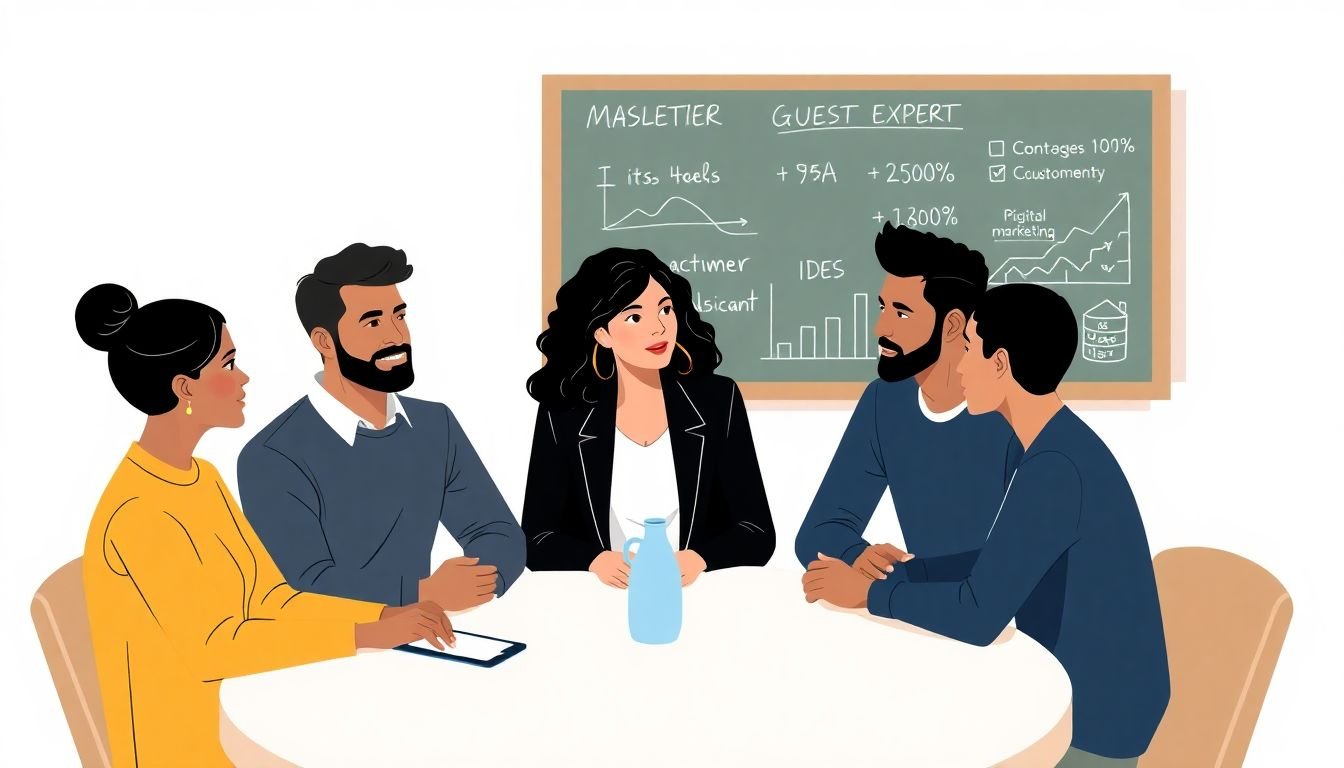
4. Create Subgroups Based on Specific Topics or Goals (So Feedback Stays Relevant)
Big pods can get broad fast. If you want real help, carve the cohort into smaller mastermind pods based on what people are actively working on.
Common subgroup buckets I’ve seen work well:
- Acquisition: lead gen, outreach, partnerships
- Delivery: onboarding, implementation, customer success
- Content & distribution: writing, video, publishing cadence
- Monetization: pricing, funnels, conversion, retention
Example: a “Social Media Strategies” subgroup might meet weekly for 45 minutes, while the “Product Roadmap” group meets biweekly for 60 minutes. Same cohort. Different pace.
To keep it from turning into cliques, add one rotating “cross-pod share” each month (10–15 minutes). Everyone gets a taste of what others are solving.
5. Use Guest Experts and Shared Resources on Purpose (Not as Random Add-Ons)
Guests can be amazing—if they’re tied to a pod problem. Otherwise they become a lecture and people leave with notes but no changes.
Here’s a practical approach:
- Pick one session where the pod is stuck on a specific issue (e.g., “writing outreach that gets replies”).
- Invite a guest expert to cover one framework and one example.
- End with a short feedback exercise: members bring a draft and get structured critique.
Shared resource library: build it like a toolbox, not a dumping ground. Include:
- Pod charter template (see step 9 for a checklist)
- Meeting agenda + facilitator script
- Commitment tracker sheet (columns: goal, deliverable, owner, due date, status)
- Feedback prompt cards (what to ask when someone brings a challenge)
- Case study prompts (how members should document what worked/what didn’t)
Where do these live? A shared Google Drive folder or Notion workspace with a simple naming convention (e.g., “Pod-Resources/Session-01/”).
Update cadence: review and refresh the library every 4–6 weeks. Ask members to contribute: “Add one resource that helped you + a 2-sentence note on how you used it.” Credit matters, and it keeps the library from going stale.
6. Build Continuous Learning With Short Challenges (So Members Don’t Fall Off Between Calls)
“Read this book” isn’t a system. It’s a wish.
Instead, set mini-challenges tied directly to the pod’s purpose. If your pod is about lead gen, the challenge should produce an artifact. If it’s about onboarding, the challenge should produce a checklist or script.
Try this simple pattern for each cycle:
- Week 1 (after session): learn a framework (30–45 minutes)
- Week 2: apply it once and create an artifact (send outreach, draft landing page, run interviews)
- Week 3 (next pod call): share results + refine next step
Example assignment (for a funnel pod): “Write 5 outreach messages using one hook formula. Send 2. Track replies. Bring screenshots or metrics to the next meeting.” That’s not vague, and it generates real discussion.
About the “big results” claim: I can’t honestly promise that every cohort doubles revenue just from mastermind pods. But I can tell you what usually drives improvement: pods create consistent feedback loops and faster iteration. If you measure conversion and you give members a structured way to test and adjust, performance tends to improve over time.
7. Use Data and Metrics to Measure Progress (Leading + Lagging Indicators)
Tracking progress keeps the pod from turning into “how’s it going?” small talk. But you don’t need complicated analytics.
Use two kinds of metrics:
- Leading indicators: the inputs you control (activities, behaviors)
- Lagging indicators: the outcomes you want (results)
Here’s a sample metrics framework you can put in a shared sheet:
- Leading: number of outreach messages sent, customer interviews completed, landing pages drafted, proposals submitted
- Lagging: reply rate, conversion rate, number of paying customers, retention rate, revenue (if that’s your goal)
Example goal-setting worksheet (copy/paste):
- Goal: (e.g., increase reply rate)
- Current baseline: (e.g., 6% reply rate)
- Target by next session: (e.g., 10%)
- Leading activity: (e.g., send 30 messages using the new hook)
- Evidence I’ll bring: (e.g., screenshots + tracker)
- Risk/assumption: (e.g., audience list is correct)
Monthly reporting cadence: once per month, each member posts a 5-bullet update in the shared doc: what I did, what happened, what I learned, what I’ll change, and my next commitment date. It’s short, but it prevents the “we talked about it but nothing changed” problem.
8. Add a Feedback Loop (With Real Questions and a Decision Plan)
If you don’t ask for feedback on a schedule, you’ll only hear problems when they’re already loud.
I like to run two quick check-ins:
- After session 2: fix format issues while the group is still adjusting
- After session 6: decide what to keep, change, or stop
Here are example survey questions you can use (Google Form style):
- Rate the pod agenda clarity from 1–5.
- How often did you leave with a clear next commitment? (Never / Sometimes / Often / Always)
- What part helped you most? (open text)
- What part felt like a time-waster? (open text)
- Did you get enough opportunity to speak? (Yes/No + explain)
- How safe did you feel sharing honestly? (1–5)
- Should we change meeting length? (Shorter / Same / Longer)
- What topic should we prioritize next? (choose up to 2)
Decision rule (this matters): for each feedback theme, decide one of three things within a week:
- Change it: adjust agenda, norms, or subgrouping
- Test it: run a small experiment next session (e.g., 10 minutes more deep dive)
- Leave it: explain why (so members feel heard)
Example: if multiple members say “we don’t get enough time for questions,” don’t just say “noted.” Add a dedicated 10-minute “clarifying questions round” before feedback. It’s a small tweak that makes a big difference.
9. Manage Group Dynamics With Clear Norms (and a Simple Facilitation Script)
Group chemistry matters. But chemistry isn’t random—it’s built through norms and facilitation.
Start by setting expectations early. I recommend a one-page pod charter that everyone signs (even digitally). Here’s an outline you can use:
- Confidentiality: “What’s shared in the pod stays in the pod.”
- Respect rule: critique ideas, not people.
- Participation expectation: everyone speaks at least once per session.
- Feedback style: 1–2 suggestions max, then ask permission before offering more.
- Time discipline: time-boxed speaking to protect quieter members.
- Conflict protocol: address issues privately first, then bring it to the pod only if needed.
- Follow-through: commitments are tracked; missed commitments trigger a “what got in the way?” check-in.
Confidentiality checklist (quick add-on):
- Do not share screenshots or private details outside the pod.
- Ask before quoting someone’s numbers or outcomes publicly.
- If a legal/compliance issue comes up, pause and escalate to the cohort organizer.
Facilitator script (use this verbatim if you need it):
- “We’re here for action, not just discussion. Each person will leave with one commitment.”
- “When we give feedback, we’ll ask clarifying questions first—then offer suggestions.”
- “Let’s keep suggestions to two per person so the main speaker can choose what fits.”
- “If you’re taking over the conversation, I’ll pause you. That’s not personal—it’s for fairness.”
What about quiet members? Use a gentle prompt: “We haven’t heard from you yet—what’s your take?” If they don’t want to speak, offer a chat response instead. Participation can be verbal or written.
10. Foster Long-Term Relationships (Make It Easy to Stay Connected)
Pods shouldn’t feel like a once-a-month meeting where people vanish afterward. Community is what keeps accountability alive.
Set up a lightweight online space (Slack/Discord/Facebook group). Then add prompts that don’t feel forced:
- “Share one win since the last call.” (every week)
- “Ask for help: what’s your blocker right now?” (every other week)
- “Resource drop: post a template/checklist and how you used it.” (monthly)
Social events: keep them small. A 30-minute coffee chat or a virtual coworking session beats a big “retreat” that people dread.
Here’s the part I’ve found most effective: assign rotating “community roles.” For example, one person per pod is the “resource curator” for a month, and another is the “welcome buddy” for new members or returning members after breaks. It gives people a reason to show up.
Think of your mastermind pod as more than a call. It’s a network members can rely on when they’re stuck—and a place they actually want to be.
FAQs
The main purpose is to create structured support that leads to real action. A clear pod purpose keeps discussions focused, builds accountability, and helps members make measurable progress toward shared outcomes.
I’d choose people who are reliable and willing to contribute. Look for complementary skills, a genuine commitment to growth, and the ability to give honest feedback without being harsh. Consistency beats “talent” most of the time.
Use a video platform for the calls (Zoom is a common choice), plus a shared calendar for scheduling (Google Calendar works great). For tracking commitments, a shared doc or spreadsheet is enough—what matters is that everyone can see follow-ups and due dates.
Keep a time-boxed agenda, require pre-work, and end every session with commitments. Also, ask for feedback after early sessions (like session 2) so you can adjust quickly. Engagement follows when people feel the format is working for them.