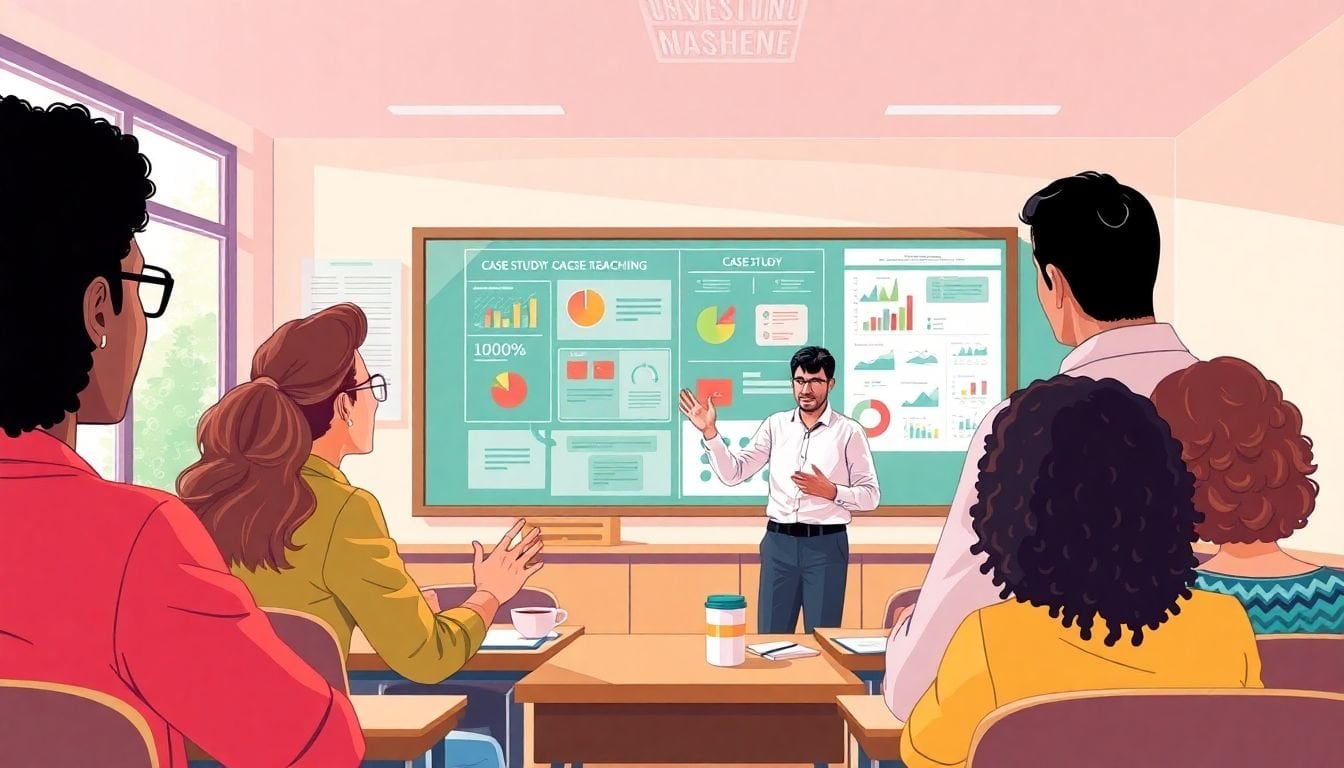
Effective Case-Based Learning Strategies in 8 Steps
Let’s be honest—case studies can be the fastest way to lose a room. I’ve watched it happen: you put a “realistic” scenario on the slides, ask for diagnoses, and suddenly you’re getting ten-second answers, blank stares, and that awkward silence where nobody wants to be the first wrong person.
In my experience, the problem usually isn’t the cases. It’s how they’re used. If you don’t build in structure (timing, prompts, roles, and a way to check reasoning), students end up treating the case like a trivia question instead of a learning tool.
So here are eight practical, classroom-ready strategies I’ve used to turn case-based learning into something students actually engage with—without turning your lessons into a chaotic free-for-all.
Key Takeaways
- Use active learning every time: run a 2-step prompt (individual write-out for 3–5 minutes, then discussion for 5–7 minutes) so students produce a reasoning trail—not just guesses.
- Build critical thinking with a “reason + evidence” question stem: require students to cite 2 clues from the case before they propose a decision.
- Make group work work by assigning roles (e.g., summarizer, evidence hunter, challenger, reporter) and using a simple check-in after 10 minutes.
- Align cases to learning outcomes by mapping each case section to one outcome (e.g., “drug interaction reasoning” or “triage prioritization”) so students see the purpose immediately.
- Lead discussions with a question ladder: start with “What do you notice?” then move to “What would you do?” then “What would change your mind?”
- Assess in more than one way: pair a case discussion with either a short written justification (150–250 words) or a role-play so different strengths are visible.
- Keep scenarios real and usable: use professional constraints (time pressure, incomplete data, resource limits) so students practice decision-making under conditions that match the field.
- Improve fast by collecting feedback mid-unit (2–3 targeted prompts) and adjusting one thing per week—usually the timing or the question stems.
1. Use Active Learning Techniques (So Students Actually Talk)
If your students zone out during case discussions, don’t blame them. Most students don’t know what to do with a case until you give them a task.
Here’s what I do in my own teaching (I’ve used this in first-year health science and mid-level nursing review sessions): I break the case into two short “production” moments. Students don’t just listen—they write and decide.
Step 1 (3–5 minutes): Individual write-out. Prompt them with: “Write your first diagnosis (or best hypothesis) and list two case clues that support it.”
Step 2 (5–7 minutes): Think-pair-share. Have them compare answers and argue their reasoning, not their opinions.
Once pairs share, I ask one follow-up: “What would make you change your mind?” That one question usually forces actual thinking.
Want a simple script? Try this:
- “Before you talk—write for 3 minutes.”
- “In pairs—agree on one plan and one uncertainty.”
- “Share: one decision + one piece of evidence.”
On the evidence side, active learning approaches in health professions education are widely reported to improve knowledge and learner engagement compared with passive instruction. For example, a commonly cited synthesis is Freeman et al. (2014, PNAS), which found that active learning improves performance in STEM courses broadly (including health-related contexts). For your specific discipline, I’d still recommend you track outcomes with your own assessments—because your learners and your cases matter.
If you want more ideas, this guide to effective teaching strategies pairs well with the structure above.
2. Foster Critical Thinking Skills (Turn Opinions Into Reasoning)
Critical thinking doesn’t happen when students are “right” or “wrong.” It happens when they can explain why, and when they’re forced to confront missing information.
Case-based learning is great for this, but only if you ask questions that require evidence-based justification.
Instead of “What do you think?” try questions that include a reasoning requirement:
- Evidence prompt: “Which two details in the case are most important, and why?”
- Alternative prompt: “What’s the next-best alternative diagnosis and what evidence argues against it?”
- Risk prompt: “If you’re wrong, what’s the cost of the mistake?”
- Update prompt: “Here’s new lab data—how does it change your plan?”
Here’s a concrete example from my experience: I teach a case-based module where students often jump straight to a “most likely” answer. When I started requiring a brief “evidence list” (two supporting clues + one uncertainty) before discussion, participation got better and the quality of arguments improved. People still disagreed—but their disagreements became structured.
One practical tip: use a “clinical reasoning ladder.” Start easy, then climb.
- Level 1 (noticing): What do you observe?
- Level 2 (interpreting): What does it suggest?
- Level 3 (deciding): What’s your plan?
- Level 4 (defending): Why that plan vs. the alternatives?
And yes—privacy matters. If you use real patient examples, remove identifiers and follow your institutional guidelines. Students actually appreciate the realism when they can tell you’re handling it responsibly.
3. Encourage Group Collaboration (With Roles, Not Random Grouping)
No one works in healthcare alone—so why do we teach case studies like students are solitary detectives?
Group collaboration helps, but only when you prevent the usual failure mode: one person does the thinking while the rest “agree” quietly.
What I’ve found works best is assigning roles and using a time check.
Try this group workflow (20–25 minutes total):
- 0–5 minutes: Silent read + role assignment. Each student writes their initial hypothesis.
- 5–10 minutes: Evidence round. Evidence Hunter must point to at least 3 case facts that support the group’s direction.
- 10–15 minutes: Challenge round. Challenger asks: “What doesn’t fit?”
- 15–20 minutes: Decision round. Reporter summarizes the plan and the uncertainties.
- 20–25 minutes: Whole-class share-out (one group, then you rotate).
Roles you can copy-paste:
- Summarizer: restates the case in 60 seconds.
- Evidence Hunter: tracks which clues support each claim.
- Challenger: asks for alternatives and “what would you need to know?”
- Reporter: presents the final plan + reasoning.
For example, in a nursing-focused case, I’ll have groups analyze patient history, symptoms, and vital signs, then agree on nursing interventions with rationales. The rationale requirement is the difference between “tasks” and “clinical reasoning.”
If logistics are your pain point, tools like Google Docs or Padlet are genuinely helpful. I’ve used them for group evidence tracking—students can build a shared table like “Clue → Interpretation → Action.”
For additional classroom structure ideas, this student engagement techniques article is a solid companion.
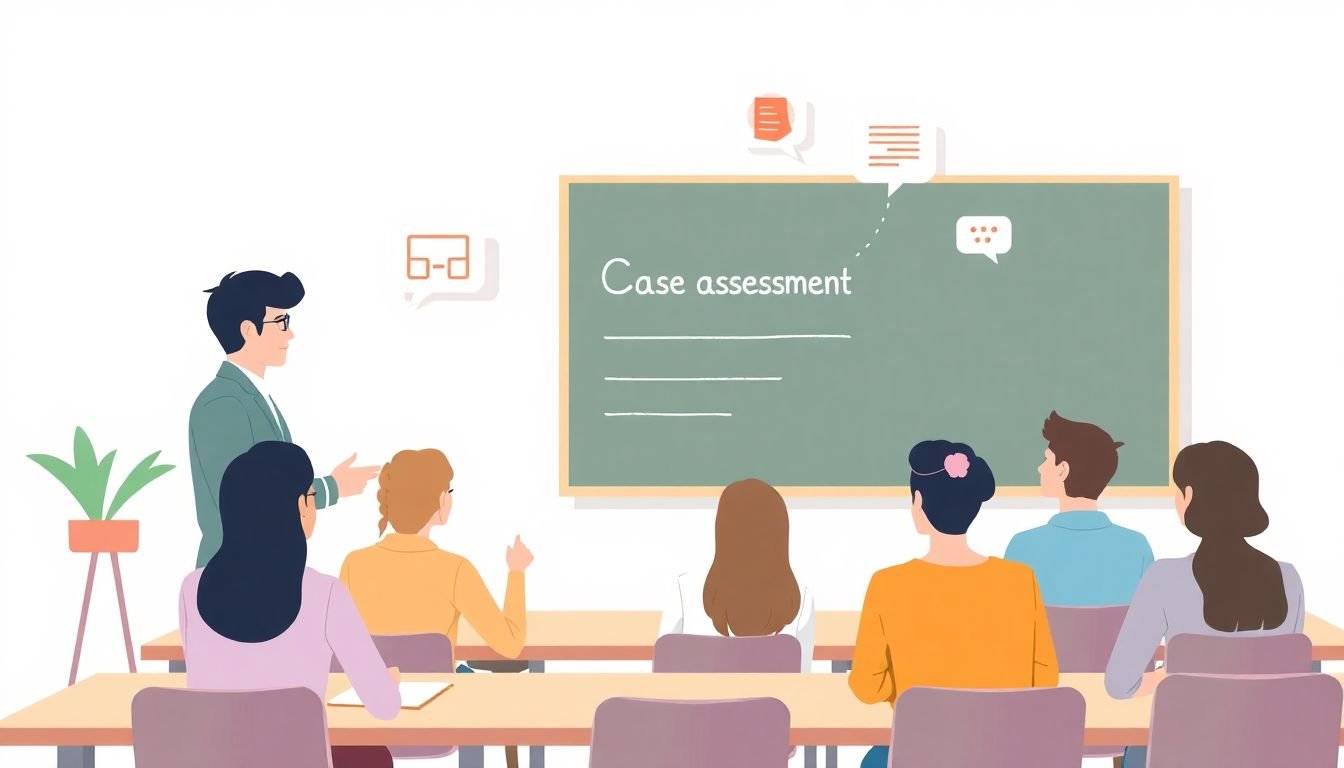
4. Align Case Studies with Course Goals (Stop Using “Cool” Cases)
Here’s the thing: a case can be interesting and still be useless for learning.
The first step to effective case-based learning is making sure each case directly supports your course goals (learning outcomes, competency statements, whatever your program uses).
When alignment is tight, students stop asking “Why are we doing this?” because they can see the connection to what they’re expected to do later.
For instance, if you’re teaching pharmacology, don’t pick a random general medical story. Choose a case that forces students to reason about drug interactions, contraindications, and side effects. That way, the case becomes practice for the exact skills you’re assessing.
My alignment checklist (takes ~10 minutes per case):
- List your learning outcomes (3–6 max per unit).
- For each outcome, write one “case requirement” (what must students do to show that outcome?).
- Mark where in the case that evidence appears (symptoms, labs, medication list, timeline, etc.).
- Decide how you’ll assess it (discussion rubric, short justification, role-play, etc.).
If you want a quick way to organize this, the course structure resource can help you map outcomes to activities and assessments.
5. Guide Productive Class Discussions (Use a Question Ladder)
Leading a discussion doesn’t mean you sit back and wait for the room to magically find answers. That’s how you lose 15 minutes to “I think…” statements.
Instead, prepare a question ladder. The trick is moving from observation to reasoning to decision-making.
Example ladder (20–25 minutes):
- Round 1 (noticing, 3–4 min): “What details stand out? List them.”
- Round 2 (interpreting, 5–6 min): “What do those details suggest?”
- Round 3 (decision, 5–6 min): “What’s your plan and what’s your priority?”
- Round 4 (defense, 5–6 min): “What evidence supports it? What would change your mind?”
And please—skip vague openers like “What happened here?” Students freeze when the task is unclear.
One simple way to get quieter students involved: call on them with context. For example, “Hey Sarah, you mentioned X in your notes—what does that imply for the next step?” It’s not confrontational, and it rewards preparation.
If you’re looking for a research hook, discussion structure and active participation are consistently associated with better learning outcomes in health professions education. But rather than throw out vague “studies have shown” claims, I’ll stick to something you can control: your prompts, your timing, and your expectations for evidence.
6. Implement Diverse Assessment Methods (So Reasoning Shows Up)
Have you ever graded a stack of nearly identical multiple-choice questions and thought, “Okay… but did they actually learn how to reason?” Yeah. Same.
Case-based learning works best when your assessment matches the kind of thinking you want students to practice.
A single case can support multiple assessment formats:
- Oral presentation: students explain diagnosis + plan.
- Reflective writing: “What did you assume, and how did the case challenge it?”
- Group case report: a one-page summary with evidence links.
- Role-play: simulate patient communication or handoff (e.g., SBAR).
Here’s a concrete split I’ve used: after a diabetes management case, one group presents treatment options, while another group submits a short reflection on decision trade-offs. The result? Students who struggle with public speaking still demonstrate reasoning through writing, and the class gets a wider range of ideas.
Quick rubric you can reuse (5 criteria, 0–3 each):
- Evidence use: cites case details accurately
- Reasoning: logical chain from evidence → decision
- Alternatives: acknowledges at least one competing possibility
- Priority: addresses what matters most first
- Communication: clear, professional, and organized
For a note on evidence: the effectiveness of case-based approaches and active learning has been studied across education fields, including health professions. If you want a specific meta-analysis to dig into, tell me your discipline (medicine, nursing, pharmacy, etc.) and I can point you to the most relevant synthesis.
In the meantime, if you’re building assessments, this resource on how to create engaging quizzes for students pairs nicely with case-based formats.
7. Connect Learning to Real-World Scenarios (Add Constraints)
Students always ask some version of: “When will we ever use this?”
Case studies answer that question—if you make them feel like real work, not sanitized textbook exercises.
So instead of only mirroring outcomes, mirror the constraints professionals face: incomplete information, time pressure, competing priorities, and resource limits.
For example, nursing students often learn more from a realistic hospital-care scenario (with typical documentation details and protocol constraints) than from an overly abstract medical vignette.
Another thing that improves engagement: update cases with recent themes (without using identifiable details). If your course touches current public health issues, you can adapt a case structure to reflect emerging concerns—students feel the relevance immediately.
Want a simple “realism checklist” when you write or select cases?
- Does the timeline match real decision cycles (minutes/hours/days)?
- Is information incomplete (and does it force prioritization)?
- Are there realistic constraints (resources, safety rules, referral steps)?
- Do students need to communicate (hand-off, patient education, coordination)?
8. Review and Improve Learning Strategies (Make It a Feedback Loop)
At the end of the day, the best strategy is the one you refine. Case-based learning isn’t “set it and forget it.” It’s iterative.
Here’s what I ask myself after each case session:
- Were students engaged in the first 10 minutes (or did they take forever to start)?
- Did they justify decisions with evidence, or did they guess?
- Did the discussion move from noticing to reasoning to action?
- Did the assessment measure the same skills you practiced?
Collect feedback mid-semester so you can actually change things. I like a quick anonymous form with 3 targeted questions:
- “Which prompt helped you think the most?”
- “What part felt confusing or slow?”
- “If we run this again, what should we change?”
Then pick one adjustment for the next case. Usually it’s timing (students need 2–3 more minutes to write), question wording (less vague, more evidence-based), or group structure (roles reduce freeloading).
If you want more practical classroom tweaks, check out effective teaching strategies.
FAQs
In my experience, the most reliable active learning methods for case-based learning are the ones that force a product: short written reasoning (3–5 minutes), peer instruction (pairs for 5–7 minutes), and role-based tasks (e.g., patient educator, triage nurse, pharmacist reviewer). Discussions work best when you give students a “reason + evidence” prompt instead of asking for opinions only.
Use clear roles and short time boxes. Give groups one specific deliverable (for example: “a 1-page plan with 3 evidence links”) and check progress after 10 minutes. If you can, rotate roles each case so the quieter students still get the “reporting” responsibility. Also: don’t grade participation loosely—grade the reasoning output.
You can assess the same case in different ways depending on your outcomes: a short written justification (150–250 words), a group case report, an oral defense, a role-play communication task, or a self-assessment where students explain what evidence changed their mind. The key is consistency: whatever you assess should match what students practiced during the case discussion.
Pick cases that include professional constraints (time, incomplete info, safety rules, referral steps) and ask students to make decisions under those conditions. If possible, mirror real documentation and communication (e.g., SBAR handoff, medication reconciliation, patient education language). Even small details—like adding lab results that arrive mid-case—make the scenario feel authentic and help students retain the reasoning later.