
Building A Mentorship Program Within Your Course: 10 Key Steps
When I first tried to add mentorship to one of my courses, I’ll be honest—it felt like I was trying to run a mini program inside an already busy schedule. Who mentors the mentors? How do you match people without it turning into awkward small talk? And what do you even do when one pair just… doesn’t click?
That’s exactly why I’m writing this. I’ll walk you through the steps I use to build a mentorship program that actually works in a course setting—especially when you’ve got real deadlines, real students, and not a ton of time to babysit every interaction.
We’ll go from purpose and eligibility all the way to matching, check-ins, evaluation, and the tools that make it manageable. By the end, you’ll have a clear plan you can copy, adapt, and run with your next cohort.
Key Takeaways
- Start with measurable goals (ex: “75% of mentees complete 3 mentorship sessions”) so you can track whether mentorship is actually helping.
- Write eligibility rules for mentors and mentees (availability windows, experience level, communication expectations) to prevent mismatches.
- Recruit with a simple funnel (interest form → short application → quick interview) so you don’t end up with “maybe” participants.
- Use a real process flow with dates and owners (orientation, matching, check-ins, wrap-up) to reduce confusion.
- Match using a rubric built from goals + interests + availability—not just “they seem similar.”
- Train mentors with a short agenda (communication, feedback, boundaries, escalation) so pairs know what to do.
- Kick off with structure: an initiation event plus a first-meeting checklist and conversation starters.
- Run check-ins on a schedule (ex: week 2 + week 5) and have an escalation path when things stall.
- Evaluate with specific KPIs (response rates, session completion, NPS, retention) and adjust for the next cohort.
- Pick tools based on your workflow (tracking, messaging, forms) so mentorship doesn’t become extra admin.

Step 1: Define the Purpose and Goals of Your Mentorship Program
Before you recruit anyone, decide what mentorship is supposed to do for your course. Not “support students” in general—what outcome do you want?
In my experience, the easiest way to keep mentorship from becoming vague is to write 3 goals max, and each one needs a KPI (a number you can track).
Example goals you can actually measure:
- Engagement: “At least 80% of mentees complete 3 mentorship check-ins by week 6.”
- Skill growth: “Mentees submit 1 improvement plan (with mentor feedback) before the final project.”
- Retention / completion: “Reduce course drop-off by 10% among mentees vs. non-mentored students.”
Want a quick way to choose? Ask: What problem are you trying to solve—confidence, clarity, accountability, networking, career direction? Then set your KPI around that.
Step 2: Establish Guidelines and Eligibility Criteria for Participants
This is where mentorship programs usually either succeed fast or quietly collapse. If you don’t define boundaries and expectations, you’ll spend your time mediating—not supporting learning.
Mentor eligibility checklist (example):
- Relevant experience: ex. “Completed the course previously” or “2+ years in the field.”
- Availability: ex. “1 kickoff call + 2 check-ins (weeks 3 and 6)” (total ~45–60 minutes each).
- Communication: “Respond to mentee messages within 48 hours during weekdays.”
- Willingness to give feedback: can they review a short doc or help set goals?
- Comfort with boundaries: they’re not an employee replacement, therapist, or career guarantee.
Mentee eligibility checklist (example):
- Commitment: “Can attend at least 2 of 3 scheduled sessions.”
- Clarity: completes a short “mentorship intent” form (what they want help with).
- Professional behavior: agrees to respectful communication and punctuality.
What to produce for this step: a 1-page “Mentorship Expectations” doc plus a short application form.
Common failure mode: mentors sign up but can’t realistically meet the cadence. Fix: require availability windows and cap mentor load (more on that later).
Step 3: Select and Recruit Mentors and Mentees
Recruiting is not hard, but it’s easy to do it sloppily. I prefer a simple funnel so you don’t end up with a list full of “enthusiastic maybes.”
My go-to funnel:
- Step A: Interest form (5 minutes). Collect role, experience, time zone, availability, and what they want to mentor.
- Step B: Short application (10 minutes). Ask about communication style and how they’ve helped others before.
- Step C: Quick interview (10–15 minutes) for mentors only. For mentees, you can skip the interview if your application is strong.
Outreach ideas that actually work inside a course:
- Mentor recruitment post in your course community (include a “what you’ll do” bullet list).
- Invite past students who finished strong (and can share outcomes).
- Use a newsletter segment: “Help someone succeed—apply to mentor.”
- Personal invitations for your best contributors (a quick DM beats another generic form).
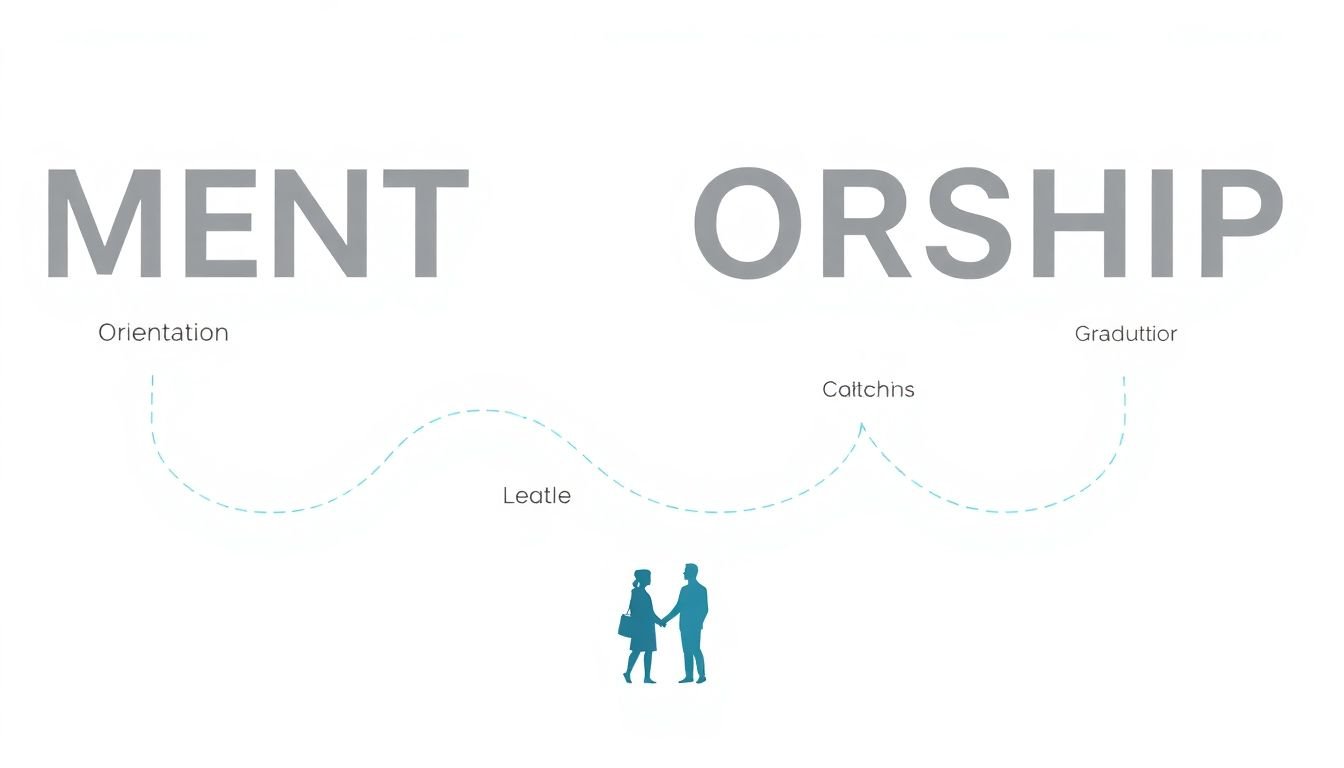
Step 4: Create a Process Flow for the Mentorship Program
Here’s the truth: mentorship programs don’t fail because matching is “hard.” They fail because nobody knows what happens when. So I always build a process flow with dates, owners, and what “done” looks like.
Sample process flow (6–8 week course mentorship):
- Week -2: mentor + mentee applications close; you review and confirm participants.
- Week -1: mentor training session (45–60 minutes) + resource pack sent.
- Week 1: initiation event + pairs scheduled for first meeting.
- Week 2: first check-in (mentor/mentee both submit a quick status form).
- Week 5: second check-in + goal progress update.
- Week 6 (or final week): wrap-up survey + optional showcase (what they learned).
What to produce: a timeline page for participants and an internal run-of-show for you.
Common failure mode: pairs schedule meetings “sometime” and time runs out. Fix: require a scheduled first meeting by a specific date (ex: end of Week 1).
Step 5: Match Mentors with Mentees
Matching is where people expect magic. It’s not magic—it’s a rubric. If you match based on a few meaningful factors, you’ll get better relationships and fewer dead-end pairs.
Build a matching rubric (example scoring out of 20):
- Goal alignment (0–8): mentee’s top goal matches mentor’s experience.
- Topic overlap (0–6): shared interests or skill areas.
- Availability/time zone (0–4): can they realistically meet?
- Communication style (0–2): ex. “direct feedback” vs “coaching questions.”
Matching inputs to collect: a mentorship intent form, mentor expertise tags, and availability windows.
My lesson learned: if you only match on “topic,” you’ll still get mismatches when one person wants weekly momentum and the other wants occasional guidance. So include cadence in the form.
Common failure mode: you match perfectly on paper, but the relationship feels off. Fix: allow a “re-match request” window (ex: after the first check-in) and set rules for how it works.
Step 6: Provide Resources and Training for Participants
Don’t assume mentors know what to do. Even great people need structure—otherwise they fall into either “inspirational talk” or “here’s what I think” with no plan.
Mentor training agenda (45–60 minutes):
- What mentorship is (and isn’t): boundaries, expectations, and escalation.
- How to run a session: agenda flow (check-in → goals → action steps → recap).
- Feedback basics: use “observations → impact → suggestions.”
- Conflict prevention: how to handle missed messages, stalled pairs, or mismatched goals.
- Escalation path: when to contact you and what info to include.
What to provide (resource hub items):
- Mentor playbook (session structure + do/don’t list)
- Mentee goal worksheet (1-page “What I’m working on / what I need”)
- Conversation starter list (10 prompts)
- Feedback template (short and easy to reuse)
- Optional: a sample “first meeting” agenda
How to measure success from this step:
- Training completion rate (target: 90%+)
- Mentor confidence score (quick post-training survey)
- Session completion rate by week 2
Common failure mode: mentors don’t use the templates. Fix: require a “submitted artifact” (ex: after week 2, mentees upload their goal worksheet revision with mentor notes).
Step 7: Initiate Mentoring Relationships
This part matters more than people think. When you launch mentorship without structure, it turns into chaos: people forget, meetings get delayed, and everyone assumes someone else will start.
Do an initiation event that includes:
- Short welcome + mentorship expectations recap (5–10 minutes)
- Pair introductions (icebreaker prompt)
- “How to schedule” instructions (send a calendar link or scheduling form)
- A first-meeting checklist
First-meeting checklist (example):
- Confirm goal(s) and define “success” for the next 4–6 weeks
- Pick 1–2 actions the mentee will take before the next check-in
- Agree on communication cadence (ex: message within 48 hours)
- Set the next meeting date before ending the call
Common failure mode: no one schedules anything. Fix: require that the first meeting is scheduled within 7 days of matching (and remind them twice).
Step 8: Guide Participants Towards Success
Mentorship isn’t “set it and forget it.” I treat it like a support system with light project management.
Use a check-in cadence that fits your cohort size:
- Cohort 1–25 pairs: check in week 2 and week 5 (plus you review messages if needed).
- Cohort 26–60 pairs: check in week 2, week 4, week 6 and use a triage form for issues.
- Cohort 60+ pairs: add a mid-point “office hours” session and assign escalation ownership (so you’re not the only point of contact).
What to ask in check-ins (keep it short):
- Have you met? (Y/N)
- If yes: did you cover goals + next steps? (Y/N)
- Any blockers? (select from list)
- Rate the match (1–5)
- Need admin help? (Y/N + notes)
Common failure mode: mentees get quiet after week 2. Fix: mentors should send a simple “action recap” after each meeting (1–3 bullets) so momentum doesn’t vanish.
Step 9: Monitor and Evaluate the Mentorship Program
This is where mentorship becomes better over time instead of repeating the same mistakes.
Use evaluation on three levels:
- Process metrics: meeting scheduled rate, session completion rate, response time.
- Experience metrics: satisfaction (1–5), perceived usefulness, match quality.
- Outcome metrics: goal completion, course completion, and retention (where possible).
Example KPI targets (adjust for your course):
- 80%+ of mentees complete at least 2 sessions
- 75%+ report the mentorship helped them stay on track
- Match satisfaction average 4.0/5 or higher
What to produce: a final report template (for you and stakeholders) with charts and 3 recommended changes for the next cohort.
Common failure mode: you collect feedback but don’t act on it. Fix: pick only 1–2 changes for the next round and communicate them (“we changed X based on your feedback”).
Step 10: Consider Software and Tools for Program Support
Tools won’t make mentorship “better” by themselves, but they will save you from admin overload—which is usually the real reason mentorship programs die.
What to look for in mentorship software (or course tooling):
- Forms for applications + availability
- Matching support (tags, scoring, exports)
- Scheduling links or reminders
- Check-in forms and tracking dashboards
- Messaging or a structured communication channel
In my experience: if you’re running mentorship inside your existing course platform, you can often get 80% of the value with forms + a simple tracking sheet. The moment you have lots of pairs, you’ll want automation for check-ins and reminders.
Common failure mode: tool complexity creates “another place to log in.” Fix: keep the mentorship workflow in one primary place (and send reminders by email if needed).
FAQs
For most course mentorship programs, 45–60 minutes is enough. I’d include the session structure, feedback basics, boundaries, and your escalation path. If your mentors are brand new (or you’re doing a longer mentorship), add a second 30-minute practice session where they role-play a “stalled pair” scenario.
It depends on your cadence. If you want mentors to do 3 meetings total (kickoff + 2 check-ins), a ratio of 1:3 to 1:5 is a good starting range. If your mentors are doing heavier reviews (like reading drafts), cap it closer to 1:2 to 1:3.
At minimum: availability (specific windows), expected session count, communication turnaround (ex: 48 hours), and what “success” means for the mentorship period. For mentees, also include a short intent form so you can match on goals—not just demographics.
Have a clear escalation path. First, check whether the issue is scheduling (then offer a scheduling template or alternative times). If the pair hasn’t met by your deadline (ex: end of Week 1), trigger a “re-match request” window and move one mentee to a backup mentor. The key is to act early—waiting until the end kills trust.
Use a mix of process + outcomes. Track session completion (did they meet?), goal progress artifacts (did they complete the improvement plan?), and retention/course completion (did mentorship reduce drop-off?). Satisfaction is useful, but it won’t tell you whether students actually improved or stayed engaged.